An RFP costs you a week you never bill.
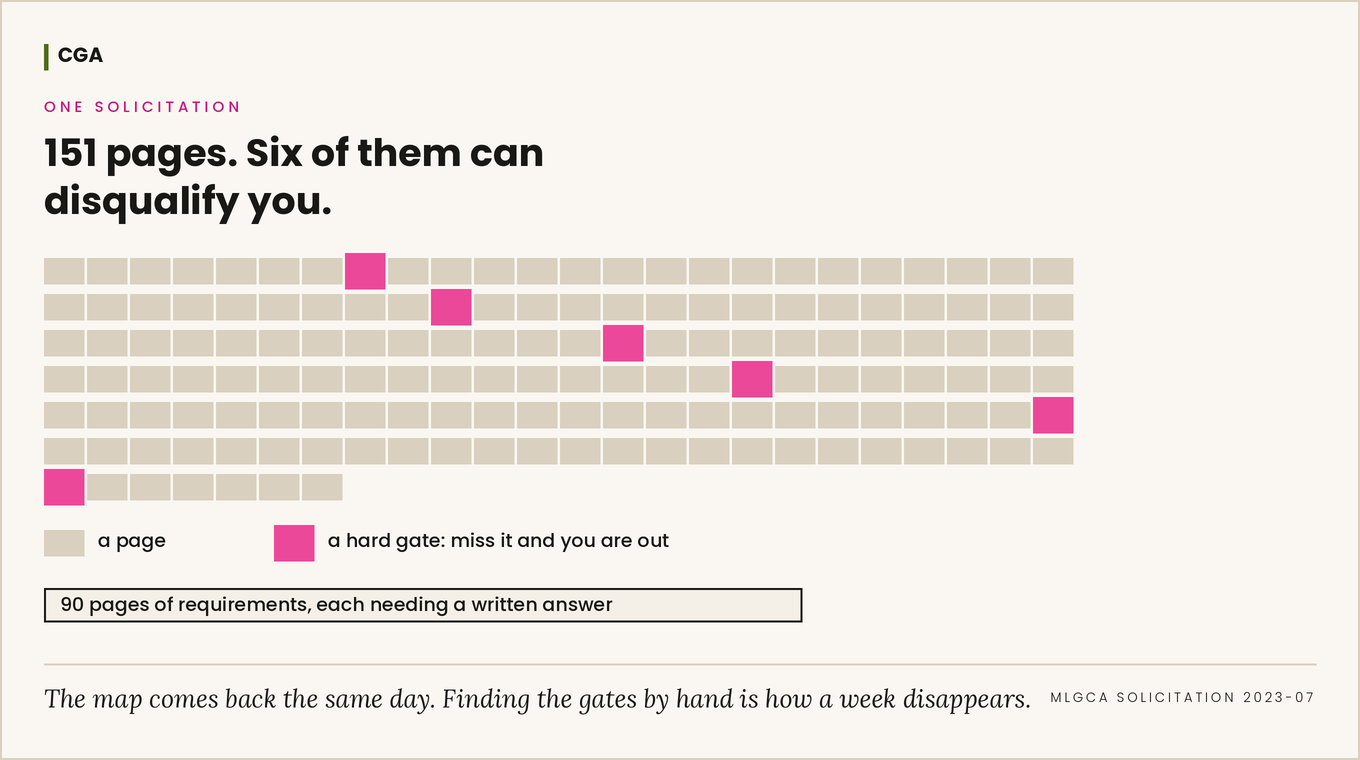
Our system read a 151-page state advertising solicitation and drafted the response, trained on the agency's own published work.
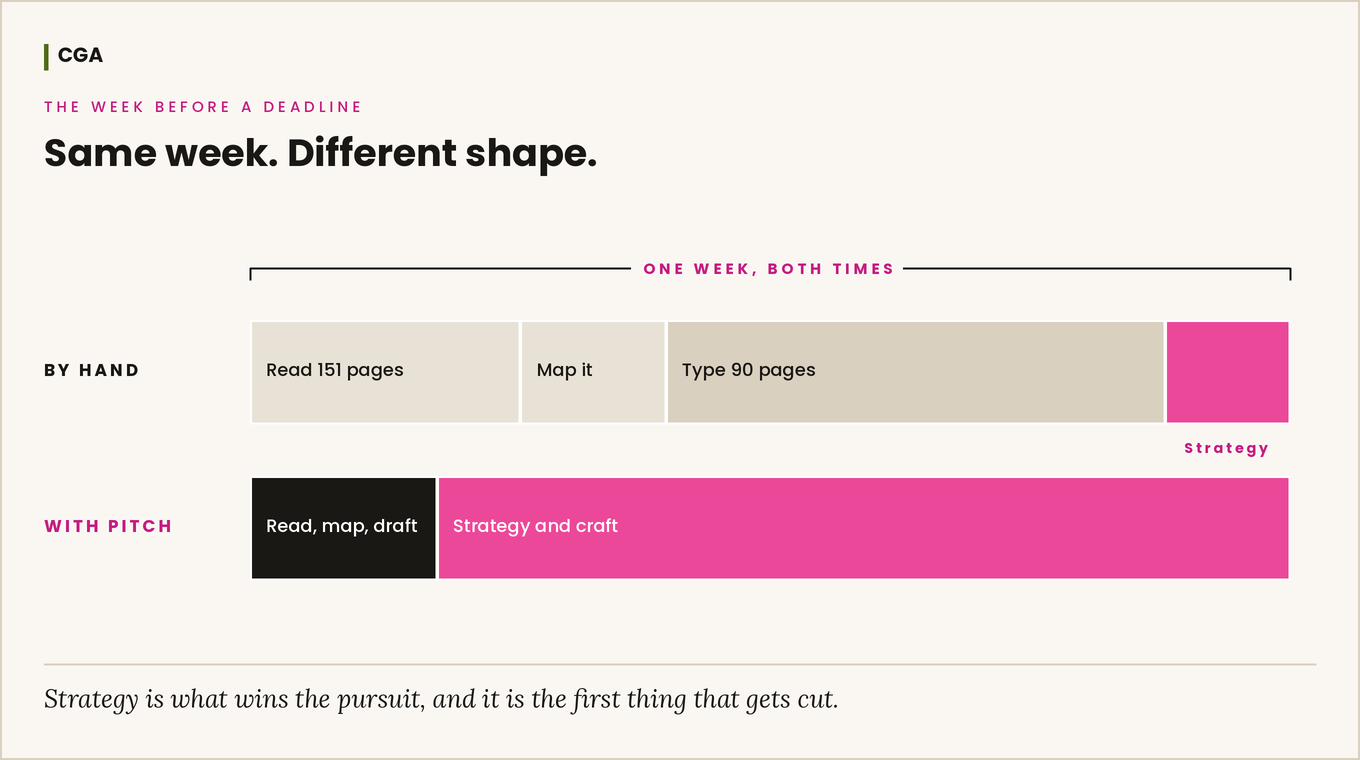
Most agencies chasing public and enterprise RFPs run the same play. Someone senior clears their calendar, reads the whole document, builds the compliance map by hand, and then writes ninety pages of requirement answers in the last four days. The strategy that wins the work gets whatever hours are left over.
One system, calibrated to one agency's own writing, carries the compliance read and the first full draft, so the team spends that week on the thinking instead of the typing. It does not go looking for RFPs. You bring the ones you want to win.
How it works.
You hand it the RFP.
You already know which pursuits you are chasing. Give it the document and it reads every page, then returns the compliance map: the required structure, the hard gates that disqualify a proposal, the scoring, the deadlines. Finding the RFPs is your job and stays your job.
You set the strategy.
You feed it the direction and the narrative you want to run for that pursuit. That part stays yours, every time.
It drafts the response.
Every writing section in order, cross-referenced to the RFP's own numbering, in your voice, because the working version is trained on your file of past winning proposals. Where a fact lives only inside your shop, the draft marks the slot rather than inventing something.
Your team edits instead of writes.
The week before the deadline goes to strategy and craft.
We ran it on a real one.
Maryland Lottery and Gaming Control Agency, Solicitation 2023-07: the 151-page advertising RFP issued September 9, 2024. We chose it on purpose, because it is public, it was actually won, and the winning and losing prices are on the record. Anyone can check the output against what really happened.
The system produced the compliance read across all 151 pages and the writing spine of a full Volume I response: executive summary, understanding and approach, all fourteen creative-scope subsections, work plan, staffing frame, experience, and the required affirmations.
We train it on your documentation.
Every install starts with your material. We read what your shop has already written and pull out the structure underneath it: how you open, how you answer a requirement, the registers your reviewers expect, the claims you stand behind. That extraction is the work, and it is the part a generic tool cannot do.
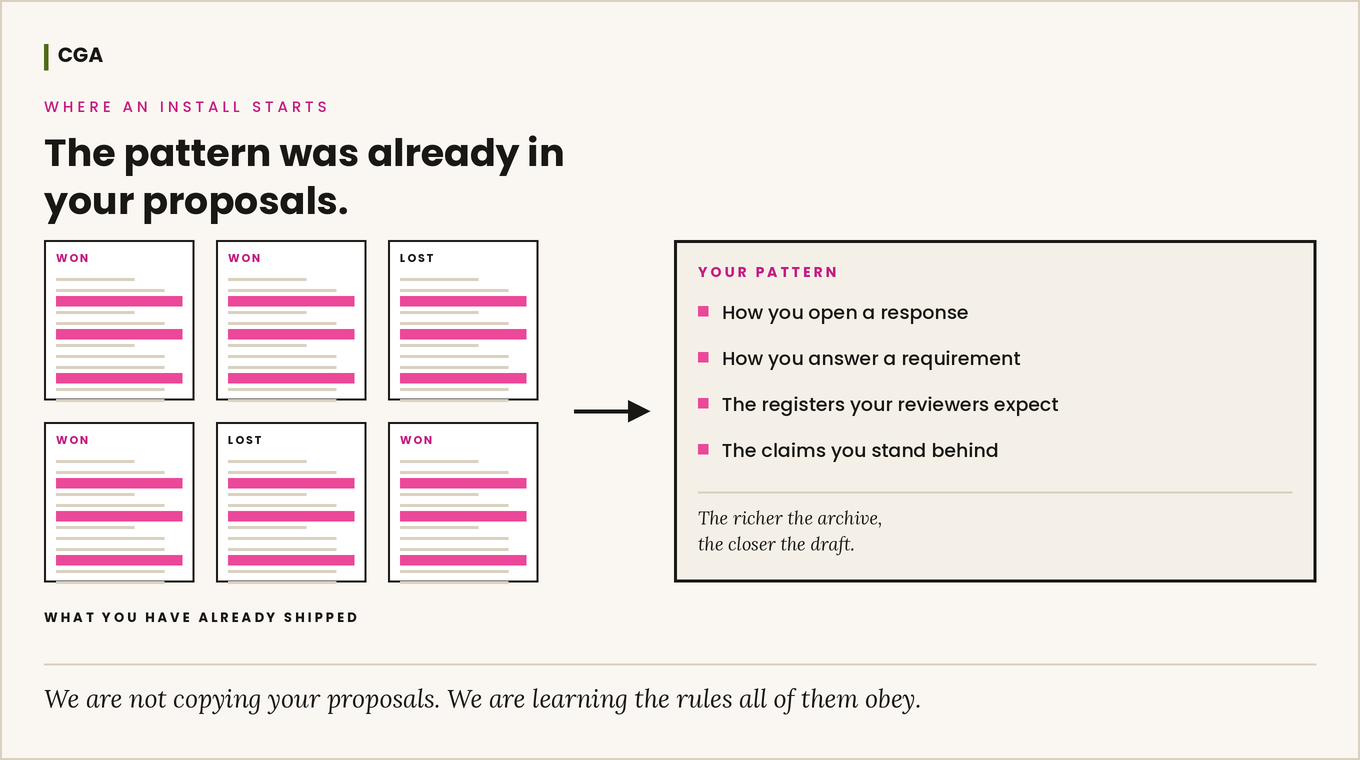
- Your winning proposals, and the losing ones, which teach as much
- Your roster, references, billings, and boilerplate
- Your past performance record
- The solicitation itself, every page of it
- The compliance map: structure, hard gates, scoring, deadlines
- The full writing spine of a response, section by section
- Your voice, because it was built from your writing
- Marked slots where only your shop has the answer, never invented
The richer your library, the closer the draft. An agency with ten years of proposals in a drive gets a system that writes the way that agency writes.
What it costs.
To install and calibrate the system on your agency's own file of past proposals. Ongoing support is quoted per agency depending on volume.
The first run happens on a real RFP you are actually chasing. We run it, you read the output, and anything that does not come back the way you need, we fix.
Start a conversation