It’s always your fault.
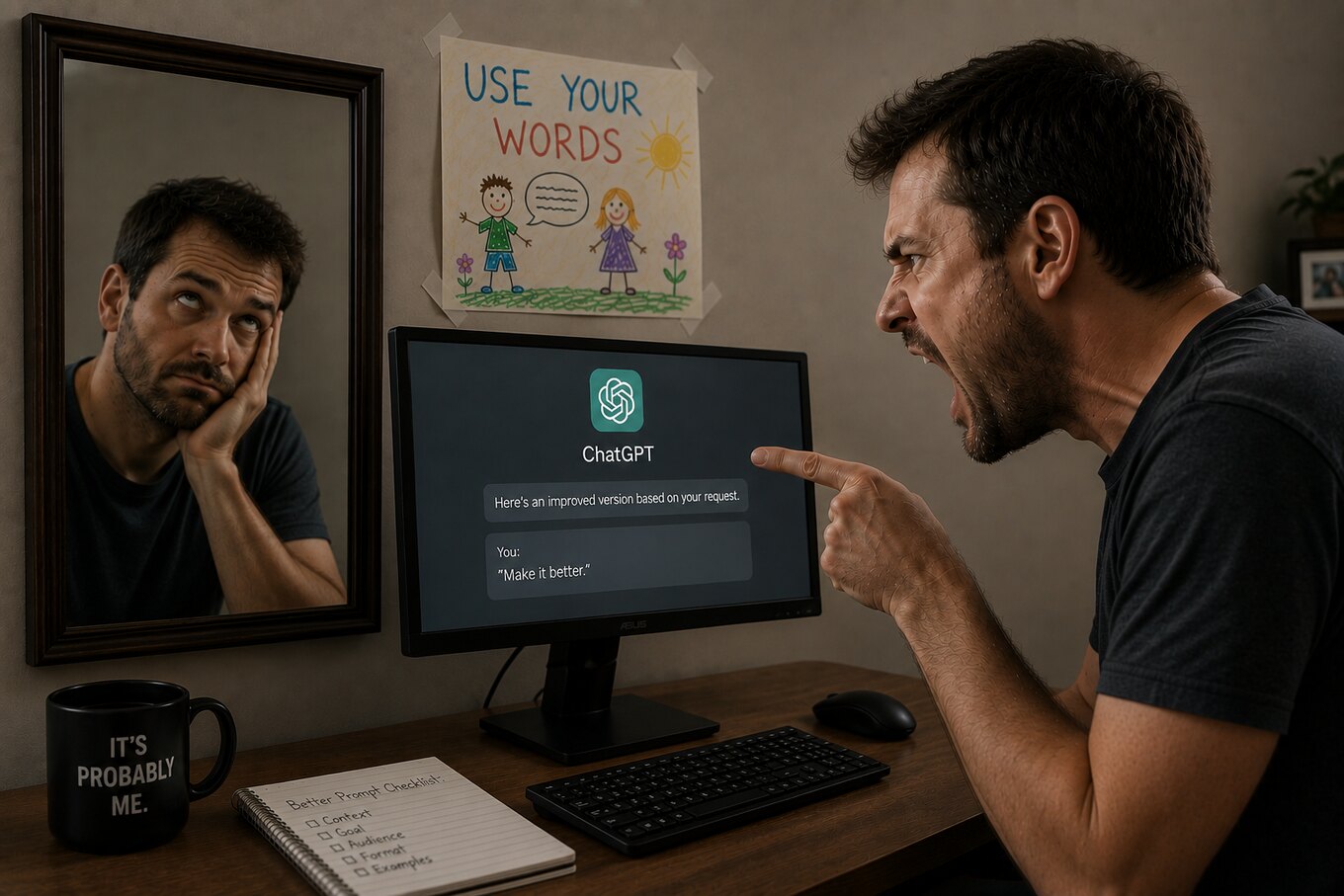
It’s probably me.
I first heard that phrase in the context of losing touch with people.
You can’t complain that you’ve grown apart if you never called. You can’t blame the distance if you did nothing to close it.
I immediately connected with the idea.
Lately, I try to remember the lesson whenever AI gives me the wrong output.
IT’S ALWAYS YOUR FAULT.
I don’t always reach that conclusion immediately. Sometimes I try to give AI consequences. I curse in all caps. I threaten to switch tools. I experience the five stages of grief.
Denial That can’t be what I asked for.
Anger Why would it possibly do that?
Bargaining Maybe rewriting the prompt for the ninth time will fix everything.
Depression I’ve wasted my life explaining camera movement to a machine.
Acceptance The prompt sucked.
Eventually, I remember I’m the only human in the room, which is embarrassing.
AI is not human. It can’t read my mind. It only knows what I communicate.
The consequences are mine. The wasted time is mine. The confusion is mine. I’m arguing with a machine.
I’m not saying AI doesn’t make mistakes. Claude owes me thousands of refunded tokens for its own fuck ups, but Dario hasn’t responded to my info@claude request yet.
Every bad output becomes the same lesson. To borrow an expression I use with my three-year-old: use your words.
Blaming the machine gives me nowhere to go. Taking responsibility does. I have to take ownership of my learning, the clarity of my communication, my energy, my sticktoitiveness.
I have to improve, so the work does too.
Fluency.
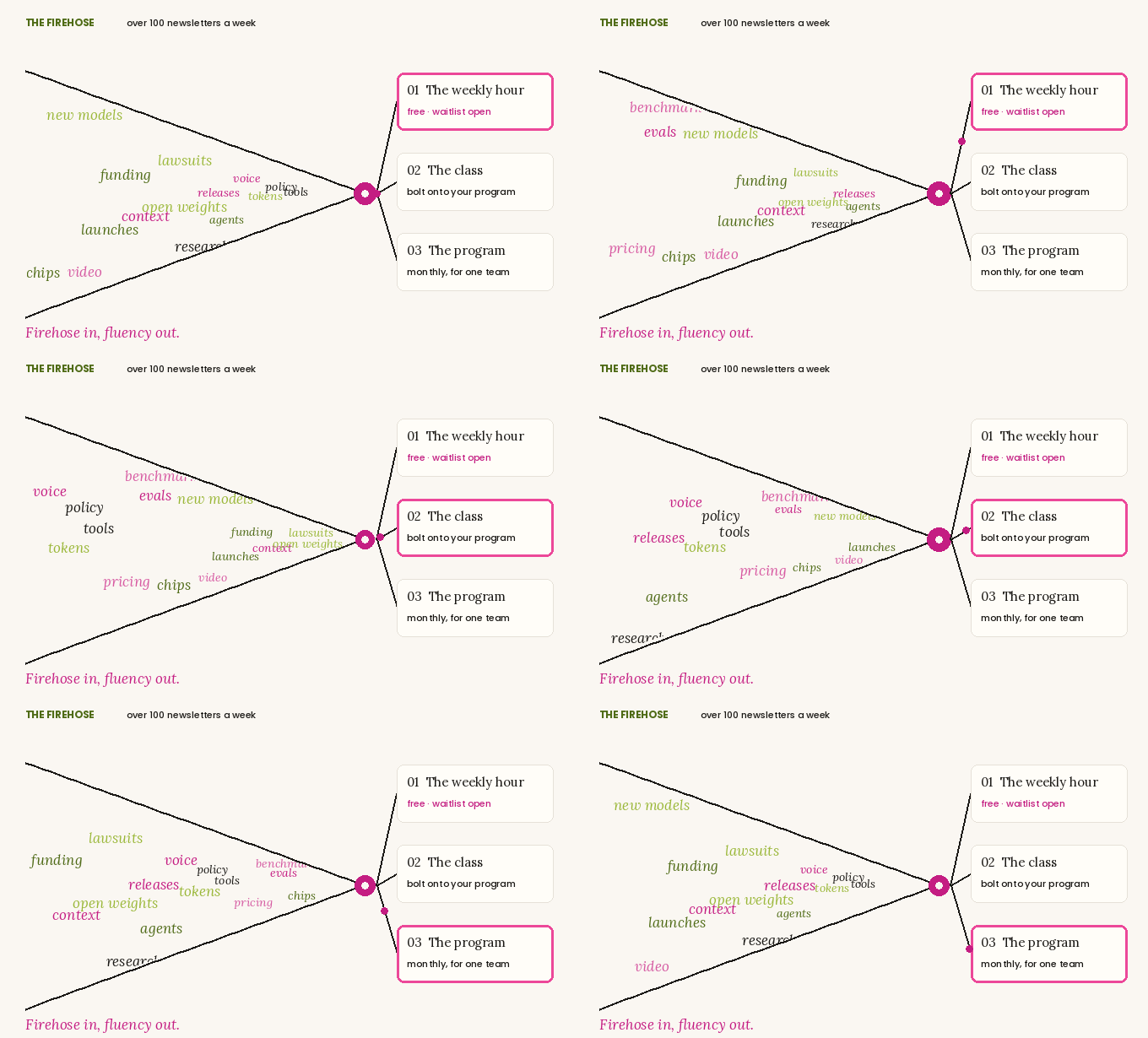
Firehose in, fluency out.
I'm developing a recurring program called Fluency. It exists because every business is getting the same question right now:
What’s our AI plan?
Nobody can keep up with this field alone. I can't either, which is why I built a system that does it for me.
Keeping up isn't the goal. The goal is using it: turning what's real this week into what's possible for your business, and then into work that ships.
Here's the ground we cover:
| 01Today's tool map | 02Shippable vs. prototype |
| 03Cost and the token economy | 04Don't touch that yet |
| 05The generative stack: video, image, voice | 06Disclosure, consent, what we won't ship |
| 07Repeatable production | 08Scaling creativity |
My full-time job is seeing this field. CGA OS, the system I run my studio on, processes hundreds of newsletters, publications, press releases, price changes, and new capabilities. It filters what's worth knowing and testing. Then I test it myself.
I've been teaching this for a while now, bolted onto corporate AI enablement programs, taught quarterly to enterprise teams, run as in-person trainings. Now I'm formalizing it in three ways.
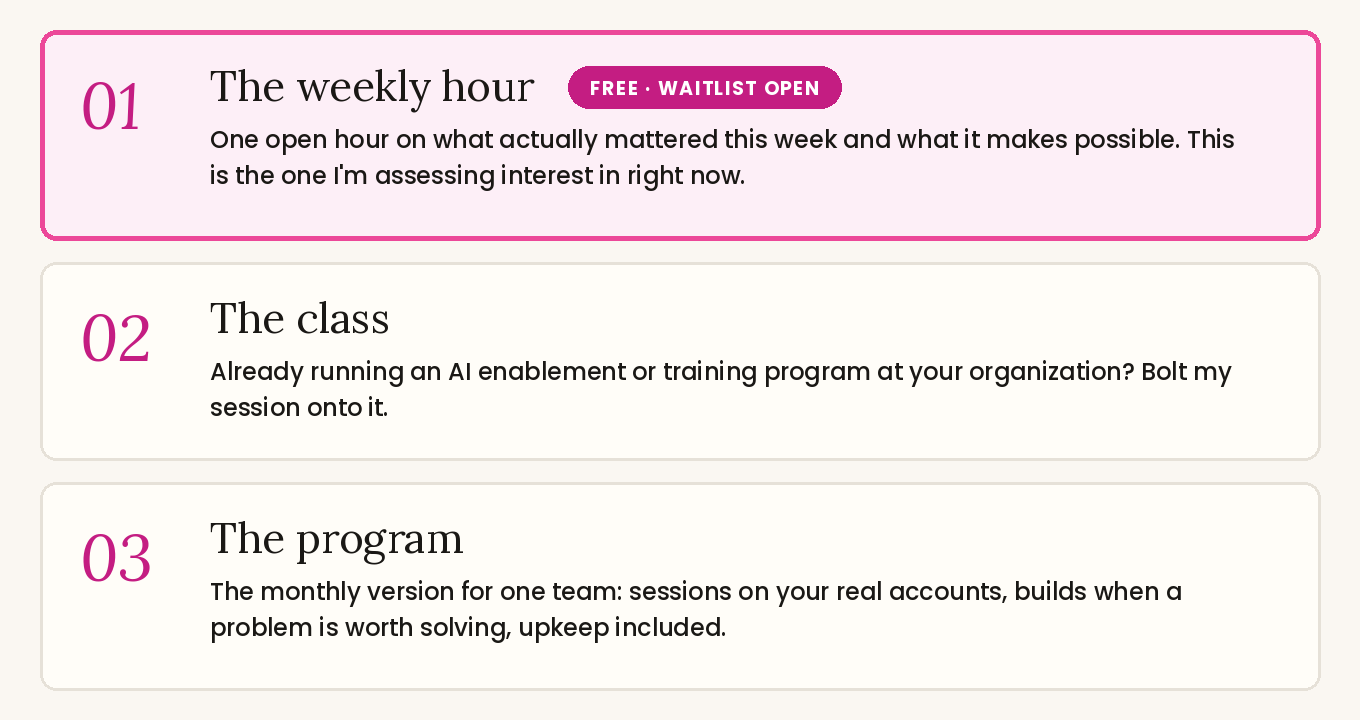
The weekly hour depends on you. If you'd want a seat, put your name on the waitlist at cgacreative.com/waitlist. It takes ten seconds, the hour is free, and if enough people sign up, I'll run it.
The Story Subscription.
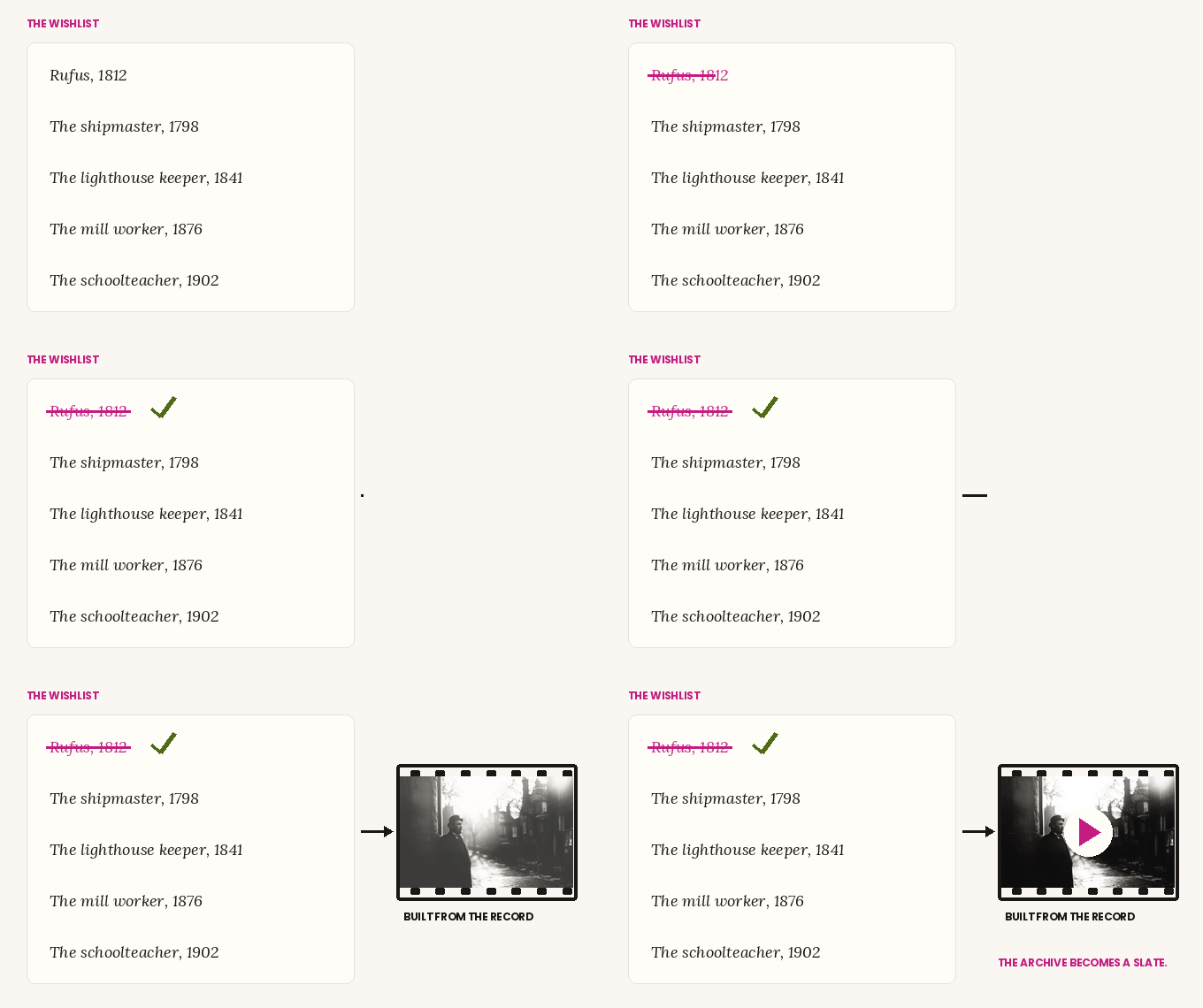
Rufus was two portraits from being lost forever.
Rufus was born in 1812 and died before anyone could film him.
His life survived in documents, two portraits, and logbooks, so I built a film from them: Rufus. It’s not a reenactment and it’s not a slideshow of old photos. It’s a resurrection.
Every museum, historical society, archive, and hundred-year-old company has a Rufus. The founder, the Black captain who owned his own ship, the woman who ran the mill. Their stories are already in your collection, and my job is putting them on screen.
It works for businesses the same way. A real estate agency serving the Bronx is exploring a slate with me called The Bronx Chronicles: six micro-docs about the community they serve, hosted on their own site. Six original films say more about their commitment to the community than any ad could.
The Story Subscription is simple. You pick the story, I make the film from your records, you premiere it, and we move down the list. Subscriptions start at $2,500 a month, and month one is the pilot: I produce your first film from your actual archive, and you keep it either way.
The full offer is at cgacreative.com/hrp-story-subscription. Pick your first story and let’s go.
Hold the green button.
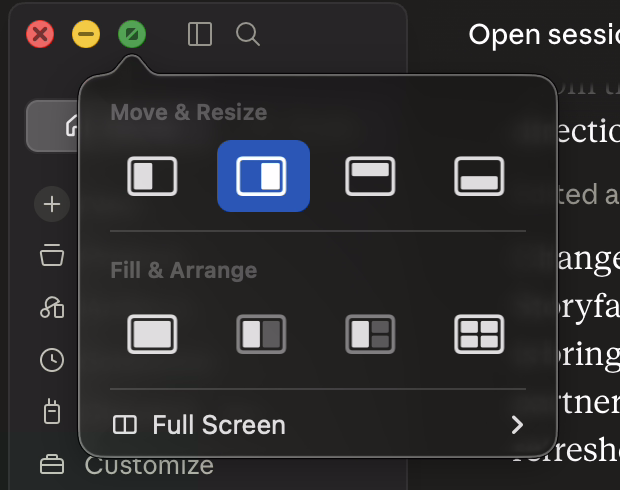
One laptop, two screens.
I was today years old when I found the simple Mac feature that fixed how I work when I'm limited to one screen: don't click the green button at the top of a window, hold it. A menu drops down offering to tile the window to either half of the screen.
That unlocked my new setup: two windows split down the middle, AI on one half, everything else on the other.
What matters? What’s possible?
01The free ride is over.
Anthropic gave away free access to Fable, its most powerful model, and extended the deal three times. On July 19 the meter turned on. This week, a Chinese lab released a model that scores three points off the frontier at half the price, and Meta priced its first paid model at a quarter of the frontier rate.
Same strategy: use the frontier models for the tough stuff and use the cheap ones for the day to day work.
0297% deployed. 79% got nothing.
Okta, the company that runs employee logins for much of the corporate world, says 97% of companies rolled out AI agents in 2026. They can see what businesses actually connect. A survey by Writer, an enterprise AI company, found 79% of them are struggling to get any value back. One widely shared investor letter put a number on why: maybe 1 in 100 employees knows how to give AI the context it needs. Then Blackstone, the biggest investor on earth, started a new firm with Anthropic, solving this with engineers embedded inside a company, feeding Claude the context of how that business actually runs. The context problem is now worth building a company around.
The gap between deployed and useful is context. Like I said earlier: the machine only knows what you communicate.
03Say something, see something.
Two things happened in AI video this week. A new model can edit video in real time, 30 frames a second, no waiting. And Google’s Omni lets you change a video by telling it what you want, while the people and the lighting stay consistent. Put them together and here’s what’s coming: you point your phone at your backyard, you say “make it the surface of Mars,” and on your screen your kids are playing on Mars while you’re still filming. Not edited afterward. Changed while you watch. I’ve already done this to my own family footage the slow way, typing the request and waiting for the render. The live version is coming fast.
04Own the model. Lose the meter.
On July 27, China’s Moonshot gives away its newest model, free to download and run on your own computers, and it scores three points off the frontier. Its launch demo worked alone for 48 hours designing a chip that runs a smaller copy of itself. That’s a nearly frontier-level model you can own outright, with no meter running. Let it work nights on your own archive and every studio gets an overnight department: it reads everything you shot, logs it, drafts the cut, and leaves a note for the morning.
05Stop typing. Start directing.
OpenAI’s newest model split a 50-year-old math problem across 64 copies of itself working at once and solved it in under an hour. The same company just shipped a $230 desk console for running agents: light-up keys, a joystick, a dial for how hard they should think. A new job is forming, and it isn’t typing. It’s directing. I spent twenty years directing camera operators with a headset and a switcher. The posture is exactly the same.
Pass it on
That is the week. Once again, my clients and I have more capabilities than we did last week.
Three ways to help this week. If you’d sit in on the free weekly hour, put your name on the waitlist at cgacreative.com/waitlist. If you know a museum, a historical society, or a company with stories, send them the Story Subscription or introduce us. And if you are putting AI in front of a team or a stage, that is work I love and I am available for it.
If you know one person who would like this, send it their way. A share is the best fuel you can give me. And if you are reading this on LinkedIn, the full issue goes out by email first. Don’t miss the next one: sign up at cgacreative.com/newsletter.

Erich
Founder · CGA Creative