Containers.
"A wooden shelf holding a life's worth of containers. Spiral notebooks, MiniDV tapes, DVD cases, well-read books, hard drives. Warm window light, dust in the light. --ar 16:9 --p --s 100"
Notebooks. Laptop bags. Bookshelves. Camp trailers. Custom GPTs. Frameworks. Mental models. The Container Store.
I love a good container.
Containers take chaos and make it usable. They preserve memories. They make complexity portable.
They help me keep the things I don't want to lose.
Ideas. Moments. Questions. Patterns. Conversations. Signals.
I've always filled notebooks, collected art, made family films, saved references, built systems.
It's all motivated by the same idea.
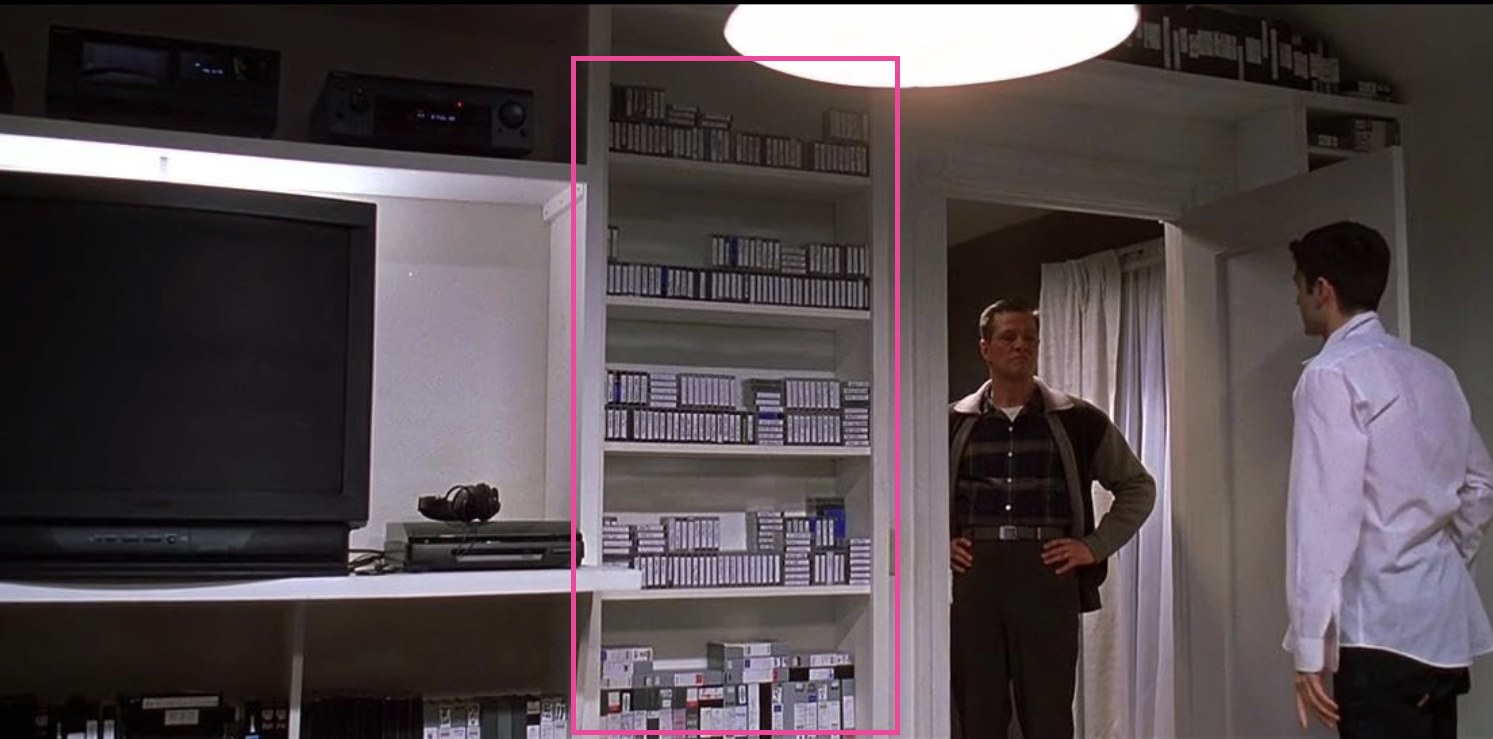
When I was 18, Ricky Fitts showed me I could use a new medium to contain moments. That changed my life.
A medium is what captures. A container is what keeps.
It was never about owning the stuff. I wanted to be able to return to it.
I've realized my life has always followed the same loop.
Notice. Capture. Organize. Connect. Create.
That was true long before AI.
AI didn't change how I think. It changed the speed at which I could think.
We used to have to wonder a lot more. You waited for the right book. The right teacher. The right conversation. The right conference. Discovery had latency.
Now curiosity is conversational.
I can follow an idea for hours. Pull on every thread. Connect it to everything else I know. Keep going until I understand something better than I did yesterday.
That's why AI feels so natural to me. Not because it's new. Because it matches the operating system I've been running my entire life.
For a while, I thought I was building GPTs. Now I think GPTs are just another container.
The real work is something deeper.
I build containers for things I don't want to lose.
Because ideas are only valuable if you can find them again. Because moments are only valuable if they can become stories. Because stories are only valuable if they change the way someone sees the world.
Maybe that's why I've always loved containers. Not because they hold things. Because they hold possibility.
Tonight only: Midjourney 8.1.
Turn the sound on. "Step by Step" by Plum.
Midjourney has been my favorite image generator for the last two-plus years, so when a new version drops, I drop everything for a test drive. This video is made from ten test prompts, chosen to test the edges of what the new model claims to improve: sharper detail, tighter prompt adherence, higher resolution.
The jump in texture and coherence is real.
All ten prompts, and the images they made, are at ten prompts, ten worlds.
What would the CIA do?
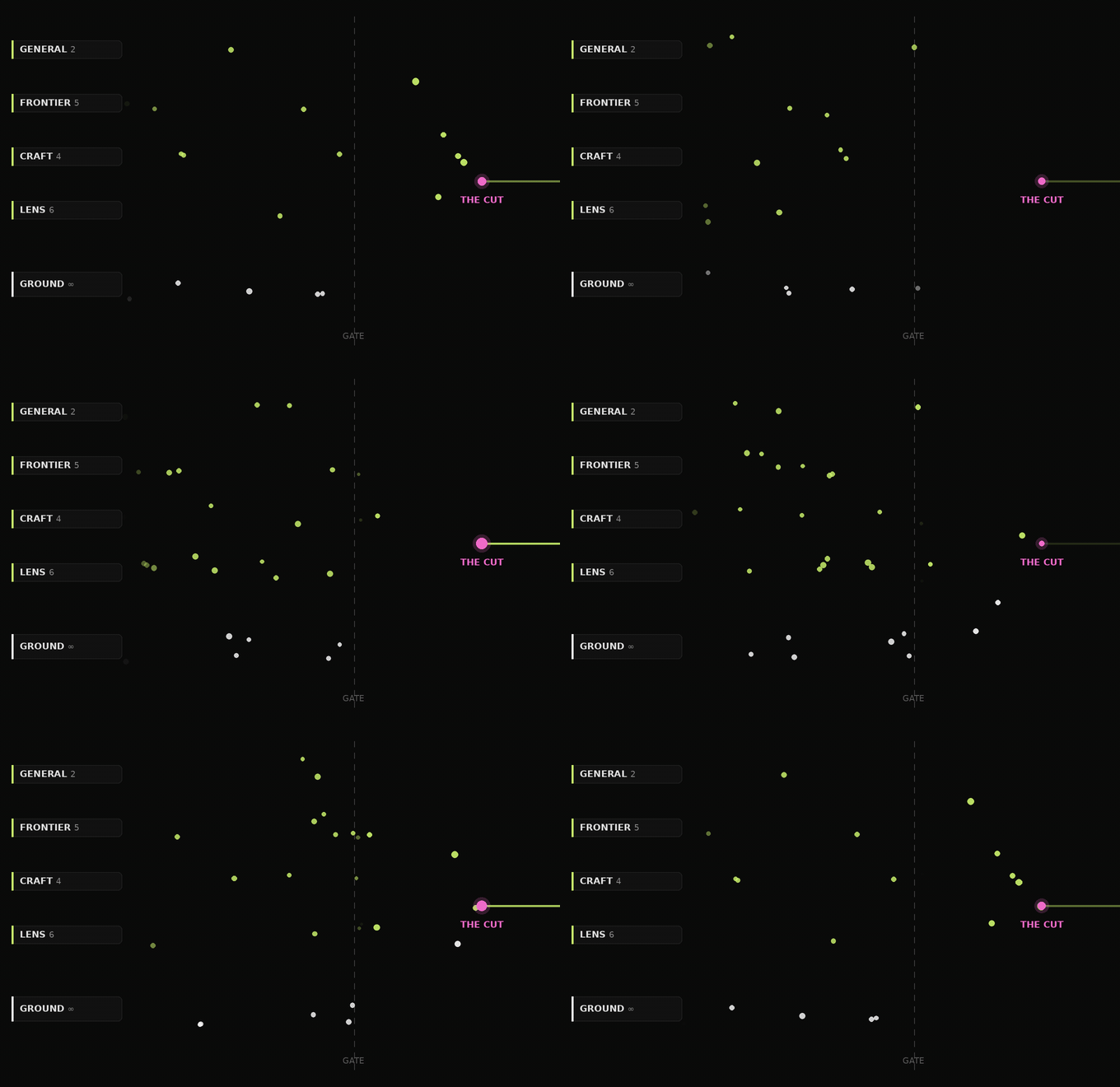
Seventeen capped sources, one filter. What survives becomes the cut.
A signal is anything that changes the way I see the world.
I find them everywhere. In books. At conferences. While traveling. Over dinner with friends.
Signals are hard to catch and easy to lose. That is a container problem. So I've been building containers that catch signals and filter them.
This week I studied how the Central Intelligence Agency does it, because finding signal in noise is their entire job. Some of my takeaways: cap your sources, and make every source earn its seat. Check whether five reports are really one report wearing five coats. Never publish a forecast without a number and a date. Judgment comes last, not first.
My version is a reading list capped at seventeen sources across four altitudes. Two for macro and culture. Five frontier scanners that Claude reads so I don't have to. Four for the craft, what we make and sell. And six writers who change how I see. Those I read myself. Every seat is earned. Candidates wait on a bench, and the bench expires.
This week was the first real test. Thirty-two AI newsletters landed in the intake. Five of them ran the same story, the government releasing the most powerful models back into the world. Five stories. Five takes. Two actual sources. The lab's announcement and one Reuters report. I used to read the same press release five times and call it staying informed.
Five sources repeating one press release count as one source.
And the widest input isn't a newsletter at all. It's my own hands. Tool sessions, client builds, failures, the Midjourney test you just watched. That layer has no cap. It's the only one nobody else can subscribe to.
Reading tells me what everyone knows.
Building tells me what nobody knows yet.
What actually mattered in AI this week.
I read more AI newsletters than is healthy so you do not have to. Here is the 5% worth your time, with what I think it means. This week you can see the machine that made the cut, one section up.
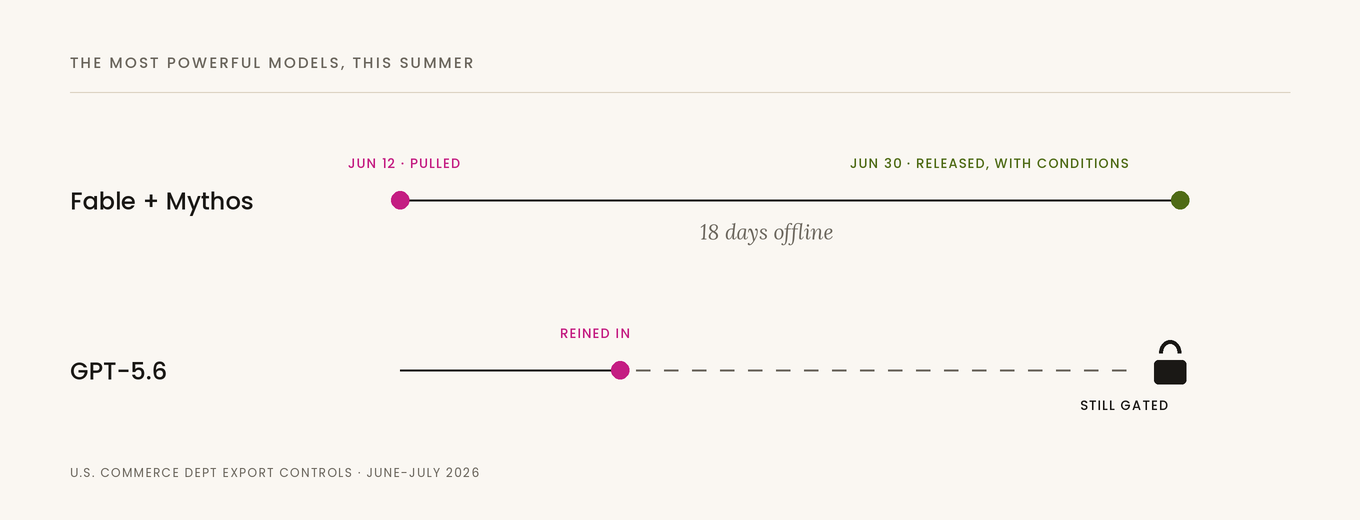
Washington gave the frontier back. Three weeks ago the government pulled the most powerful models, Fable and Mythos, out of circulation. This week it released them, with conditions: the lab agrees to detect security risks proactively, coordinate on future releases, and report malicious use. Meanwhile GPT-5.6 is still on its leash. I flagged the grounding when it happened, and the resolution matters more than the drama: this is starting to look like a template, not a one-off. Capability gets rationed, and the edge keeps shifting from "who has the best model" to "what can you build with the one you can get." That has been my bet all year. This issue was produced on Fable.
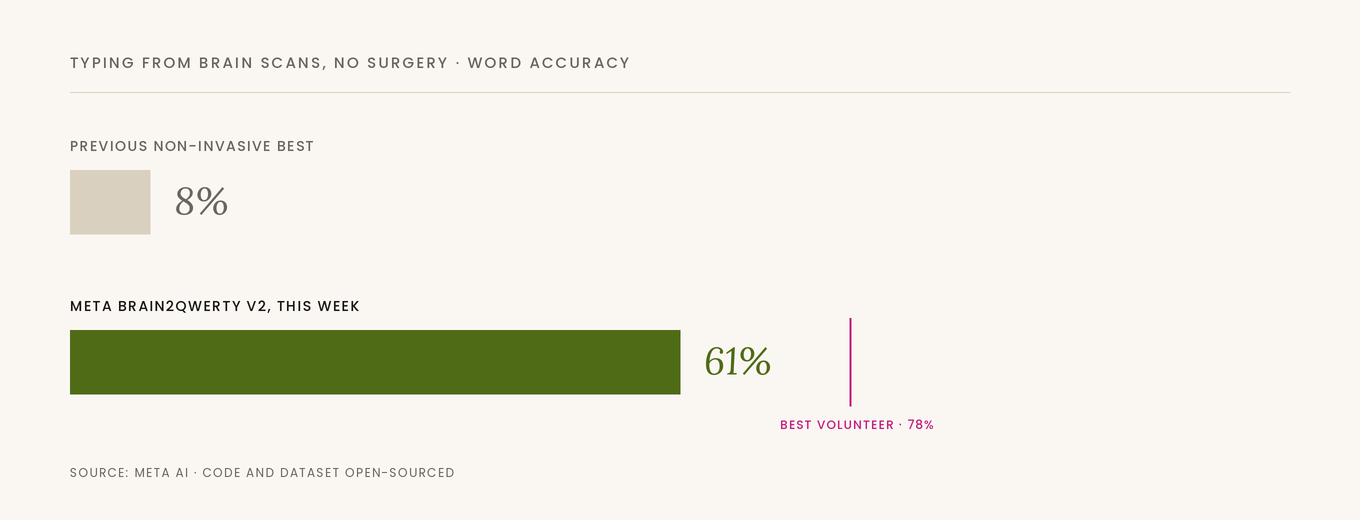
Machines learned to read another human signal: intention. Meta's new system types sentences from non-invasive brain scans at 61 percent word accuracy. The previous non-surgical best was around 8. Accuracy scales with data, and they open-sourced the code and the dataset. One source on this so far, Meta itself, so hold it loosely. But this is the same curve I wrote about with the silent films that secretly carry sound. A new sense is coming online. The question I run on every story like this is not "is it scary." It's "what does this unlock." Voices for people who lost theirs. Direction without hands. The code is free. Somebody is going to build the first beautiful thing with it.
AI stopped being an app this week. Magnific put its tools inside Claude, ChatGPT, and Cursor, shipped plugins for Premiere, After Effects, Resolve, Photoshop, and Figma, and released a short film made end to end through that connection. Luma shipped reusable workflow Skills. Midjourney made 8.1 the default. Different companies, same move: the model is dissolving into the tools you already use. The skill that survives that shift is not prompting. It is knowing what good looks like, and designing the workflow that gets there.
Pass it on
That is the week. A love letter to containers, containers for signals, and a new engine tested by hand.
If you run a business with a problem worth solving, or you know someone who does, I would love an introduction. Finding the pain and building the solution that takes it away is the whole job, and it is how I keep flying. And if you are putting AI in front of a team or a stage, that is work I love and I am available for it.
If you know one person who would like this, send it their way. A share is the best fuel you can give me. And if you are reading this on LinkedIn, the full thing lands in your inbox first. The email list is the one place I actually own.
Erich
Founder · CGA Creative