Thank you.

I started CGA Creative a couple months ago with no runway.
No funding, no safety net, no plan B. Just a couple of years of momentum, the promise of this technology, and the belief that I can fly. Most days I am running on fumes. And I am not up here alone. My wife and our four small children are in the back seat.
So when 1,600 people signed up in the first week, it was not a vanity metric. It was fuel.
From a one-off to a system.
My pilot character has quietly become the fastest way I have to tell CGA's story. Organic business content is brutal. The algorithms bury anything that smells like a company talking about itself, but a grizzled pilot in a failing plane slips right through. So I keep reaching for him. Same beard, same cracked goggles, same plane he is building while he flies it. He has starred in four of my videos now.

|

|

|

|
Here is the reflex I have built over the last two years. The moment I do anything twice, a question fires on its own. Can I hand this to AI? Can the repeating version of this become a system instead of a chore? The first pilot video was a one-off. The second time I went back to the well, I was already planning to build a system.
The moment I do something twice now, the same question fires. Can AI turn this into a system?
By the fourth video it was time to find out if I could. Training a custom image model of a character is not magic. It has a real bar, and I did not know if I had cleared it. So I asked the system I run the studio on, CGA OS, one question. Do I have enough images of the pilot to train a model of him yet? The answer was no. You need about thirty images, and you have nine.
And not just any thirty. A model only learns the character if the images are deliberately different. The same face from every angle, every expression, every kind of light, all of them sharp, all of them color-consistent. So I sat down and engineered a list of thirty exact prompts to cover that whole range. That block of text on the left of the screenshot is the list. The rest of the screen is me generating the shots that I am still missing. I combine the prompts with the reference images to get the new images I need.
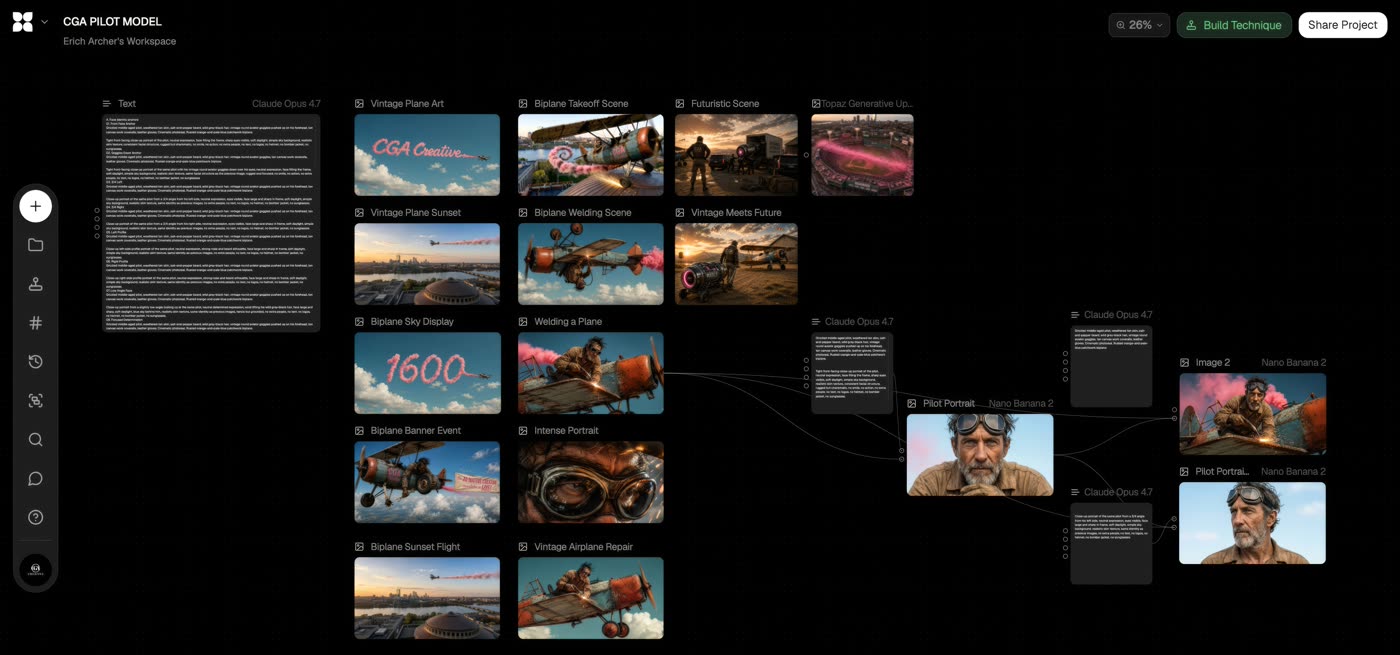
Making a custom image model set.
It is not finished yet. But when it is, the math changes completely. Instead of hand-building each image and praying it matches the last one, I will generate any pose, any scene, any message I want, the same day I think of it. A weekend of work becomes an afternoon. In a fight for attention where speed is the whole game, that is the difference between catching a moment and watching it pass. Make it once to see if it matters. The second time, build the engine.
Four tools, one auction house.
This week I was working with an art auction house out of New York that processes thousands of images. I sat down with their CEO, mapped where their week actually hurts, and shipped them four tools. Here is what they do.
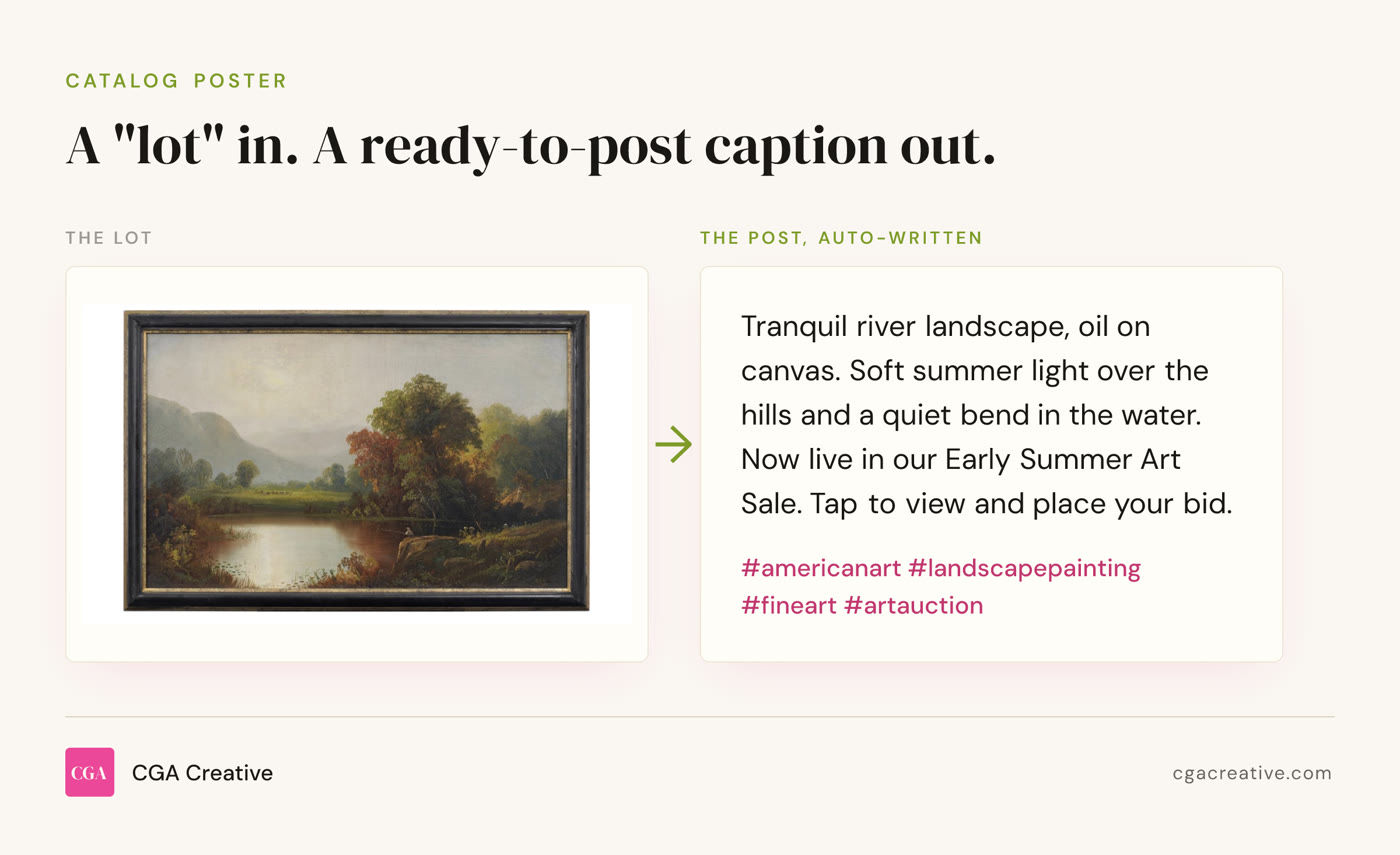
One of the four. Drop in a lot, get a finished post.
1Catalog Poster pulls any lot from their auction software and writes a finished, ready-to-post Instagram and Facebook caption in seconds.
2Lots turns a single photo of a painting into a written lot description, in the style and tagging they use.
3Estates ranks the upcoming estate sales by how worth-the-drive each one is, weighing recency, proximity, and signal.
4Photo Studio takes the whole camera dump from a sale, finds the paintings on its own, and crops, straightens, and color-corrects every one clean to the frame.
Here is why this matters, and it is bigger than one auction house. Custom software used to be out of reach for a business this size. Four tools shaped to one company's exact workflow meant a team of engineers, six months, and a budget with a comma in it. So most businesses did the opposite. They bent their work to fit whatever generic software they could rent, and swallowed the friction forever.
That just ended. I am one person. I shipped these four in a week, each one molded to how this team actually works. Not configured. Built.
For the first time, the software bends to the business, not the business to the software.
And it works for almost anyone. Every business has a week full of the same manual, repetitive, soul-deadening tasks, and every one of them is now a tool waiting to exist. This auction house is not special. It is just who I happened to sit with this week.
The part I cannot automate is the part that took me twenty years to learn. I have spent thousands of hours interviewing people on camera, learning to ask the right question and listen for the real story under the obvious one. Finding a business's pain is the exact same skill. I take that story to CGA OS, where my read of the problem meets what this technology can actually do, and we build the fix. That is the whole company, in one line.
Find the story, build the fix.
Pass it on
That is the week. Thank you for being here for it.
If you want to help keep me flying, here is the honest ask. I am looking for warm introductions to business owners and decision-makers who have a problem worth solving with AI. I find where a business actually hurts and build the custom tool that takes the pain away. On the creative side, I'm available for consulting, prototyping, and production systems building, for anyone trying to figure out how to actually put generative AI to work in their content.
And if you know one person who would like riding along, please send them this. A share is the best fuel you can give me.
Erich
Founder · CGA Creative